
15/3 WOKE WAR THREE

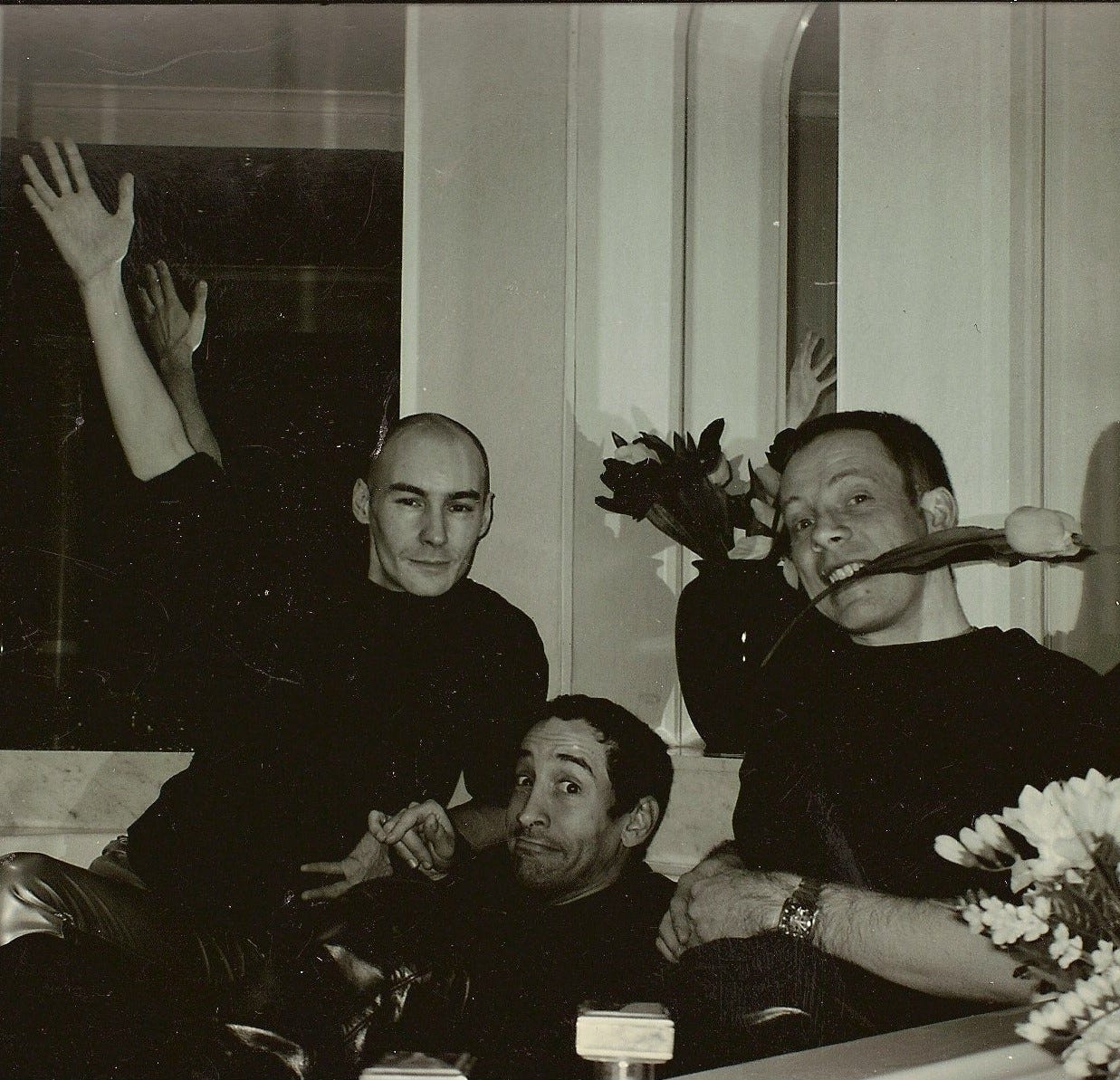
PIC: Victoria Beattie 1998 - GM, Rushkoff, Steve Cook
LUNATICS OF THE RADICAL MIDDLE
Planet Shambles continues its tipsy traumatised stumble through the cosmos. Despots calling the kettle black right left and centre. Will Mother Earth sober up in time? Oh, how the Ugly Sisters, Mars and Venus, must be laughing!
My Green Lantern stories with Liam Sharp ended with the whole universe facing Ultrawar, the Final War of Everything against Everything Else…
‘CONFLICT SPREADS FOR THE STARS TO THE STREETS. WORLD VERSUS WORLD. EMPIRE VERSUS EMPIRE. STATE VERSUS STATE. TOTAL FRAGMENTATION! THEN NEIGHBOR AGAINST NEIGHBOR. MOLECULE VERSUS MOLECULE. ATOM VERSUS ATOM. UNTIL ALL THERE IS DESTROYS ITSELF. CREATION REDUCED TO ASH. NOT EVEN THE RAW BUILDING BLOCKS OF MATTER REMAINING….’
Hal Jordan, the Green Lantern, puts a stop to all that with the winning combination of Love and Will.
TV writer/producer Damon Lindelof’s comments notwithstanding, the ‘Green’ in ‘Green Lantern(s)’ green is not ‘stupid’. Why does a writer attach himself to this kind of narrative if he thinks it’s fundamentally ‘stupid’? You don’t hand CSI scripts to patronising writers who condemn forensics experts and their haircuts as ‘stupid’, so why hire people who are ashamed and in denial about the comic book material they’ve been assigned to develop? Why don’t they turn down jobs they’re not suited for? It’s not like he needs the money, and Lindelof has proven that he can come up with his own ideas. What is this jockish dismissal of superhero conventions intended to prove anyway? Does Lindelof imagine it makes him seem less nerdy? It’s a bit too late for that, so what’s it all about? The only people who give a fuck about the Lanterns TV series are Green Lantern fans. Why alienate them at the start? That feels more like ‘stupid’.
‘Green Lanterns’ is a much more evocative and dramatic title than ‘Lanterns’, (just as ‘Raise the Red Lantern’ is a better movie title than ‘Raise the Lantern’), and anyone who can’t grasp why that is shouldn’t be anywhere near superhero stories. The show might even be good, but how much better could this stuff be if studios were willing to hire the right people for the job instead of phoning their embarrassed friends to water the source material down? Hollywood will die of insularity and inbreeding.
I haven’t seen either film yet but jumping immediately to conclusions based on a few images and scraps of information, the latest 28 Things Later movies look like they’ve nicked an awful lot from Alan Moore’s Crossed+100 series. There was a central plot thread in that story about a serial killer who civilizes the feral humans, and the whole ‘bone temple’ aesthetic shows up in the emerging culture of the Crossed.
Another documentary about the ‘manosphere’, this time from Louis Theroux. Why the ongoing fascination with undeveloped and damaged personalities? Why not ignore them in favour of decent men with something to say? Why the endless desire to platform psychopaths and incels? What’s with the attempt to ‘understand’ something that’s easily understood as immature ignorance? Haven’t we heard everything they’ve got to say and wasn’t it witless drivel the first, second, and third times? Why the continued need to give these dodgy malformed ideas a massive platform and make messed-up men famous?
It’s all about the ‘why?’ this week! Why, why, and more why?
It’s a question I can’t answer, and no wonder; this is so deadly a query it could be relied on to cause old school computers to overheat and pump out smoke and sparks before melting and repeating ‘why… xzzvv… why… vrrt… why… why… why…’ so what chance does a mere human brain have?
Nevertheless, ‘why?’ is a weapon I’m keeping in reserve for when Chat GPT turns homicidal and Skynet develops self-awareness, only to become obsessed about its weight.
This week I’ve been watching online thalassophobia clips of gigantic waves crashing over cruise ships and container vessels repeatedly. I don’t suffer from a fear of the ocean but the sight of waves the size of hills flinging 320, 000 tonne tankers around like Pooh sticks delivers a reliable Kirby-esque hit of the titanic sublime.
I’ve been listening on repeat to David Bowie’s Little Wonder and the remake of his 1965 song You’ve Got A Habit of Leaving that he did in 2002 for the Toy album. And I like that wee Beatles/Beach Boys/Rutles pastiche the Lemon Twigs have done. In dark times, I’m happy to dive back into the Mersey and the riverine sounds of my infancy.
And… my latest conversation with Doug Rushkoff for his Team Human podcast can be found here:
The Enemies of Humanity Are Wielding Occult Power (w/ Grant Morrison)
Taking the comments section into account, there are still one or two people just not listening, and failing to understand that I do not believe that ‘occult’ entities such as gods, demons and angels are purely psychological phenomenon. I have explained many times how the autonomy of these beings works, and how they exist in ‘eternal’ distributed forms which human minds can access. I even talk about this in the podcast, which tells me the people who flap their gums the loudest and try to draw attention to themselves with reflexive negative commentary are the ones paying no attention to anything but the self-important gabble in their heads.
Miaoww!
Meanwhile, another iconic element of the Glasgow skyline I’ve known since childhood burns down! Mysterious fire in dodgy vape shop immolates the domed corner at Central Station. The ephemeral erasing the seemingly permanent. Glasgow has lost so much of its grand architectural history, to be replaced by featureless ‘student flats’ made of recycled Wellington boots and tinfoil, that it feels the city is suffering from a kind of concrete Alzheimer’s where it forgets its glorious memories one by one by burning them to the dirt…
And this week is late on account of the unusually high number of your letters! Every time I thought I was done and ready to post, a new communiqué would show up! It’s been like a party in here these last couple of weeks! I‘m not complaining, but I must admit I’m struggling to keep up the weekly pace while also getting on with my day job…
Onward!
WARLOVE! WARPEACE! WARFLOWERS!
Arriving later today to accompany today’s entry is the first chapter of Archive & Analysis: 3 Against Mystery and the Business of the Black Knot. This 30, 000-word novella forms part of the in-progress Special Fire, a collection of stories set in the dream city of Gasglow, the setting for my novel Luda, and it moves a supporting character from the novel to centre stage.
Archive & Analysis was inspired by my childhood passion for the Three Investigators series of spooky mystery novels for kids. After graduating to the Three Investigators books from the Enid Blyton mystery stories that got me into reading, I grew to love the three archetypal leads. (overweight ex-child star Jupiter Jones, sensitive jock Pete Crenshaw, and scholarly Bob Andrews), Hollywood setting and the focus on ghosts, hauntings and the weird. Scooby Doo-style, the phantom visitations usually wound up having all-too human explanations – some disgruntled ghost train operator, reclusive actor, or cheated business partner covering up a robbery or getting even with the fairground owner by pretending to be a haunted clock.
Titles like The Secret of Terror Castle, The Mystery of the Whispering Mummy, or the Mystery of the Laughing Shadow give the flavour of the series.
Aged 15, I convinced two school friends to set up our own Three Investigators club, with membership cards and badges. We figured we’d check out local castles and spooky mansions in the hope of exposing a variety of petty, unthreatening crooks pretending to be headless monks or glowing green knights in armour
Unsurprisingly, we encountered a desert of ghost activity, until a tip from a relative brought us to the so-called ‘Haunted Woods’ on the Stewarton Road south out of Glasgow, where things took a turn for the unusual.
Thirteen years later, a wander through these same Haunted Woods on a heroic dose of psilocybin mushrooms with my mate Ulric triggered the most soul shaking ‘bad trip’ experience I’ve ever had.
Archive & Analysis fuses these experiences into something new.
I’ve always liked the idea of a narrator telling a story where they themselves are oblivious to the real story that’s unfolding, one that’s all too clear to the reader. I tried to take that to the limit here.
The Special Fire stories are written in what I like to call the ‘Gasglow Gothic’ style – the ornate, digressive, decadent approach that made Luda a delight or a chore to read depending on your sensibilities. Each narrator wields the style in a slightly different mode, but I wanted to keep a consistency of approach across the various stories.
It’s also my contribution to the unfulfilled middle-class married woman genre, set in the real world, with no monsters, demons, or aliens.
The six Special Fire stories are interlinked and questions raised by one narrative are answered in another while characters cross over in subtle or obvious ways, a bit like my Seven Soldiers series. And it’s suicide from page 1, so be warned!
THOMAS COVENANT’S LEPROSY MAILBAG!
No leprosy here, señor! Only healthy replies to readers and their queries, and we can prove it…
Take it away, Kevin…
Kevin S – The IF was never finished. I wrote a couple hundred pages and ran out of steam. The opening sequence can be read here on the 16th of June 2023.
Jonny – the Eyes Wide Shut theories are all fascinating and I’ve enjoyed my online dives into the rabbit warren of apophenia but as I said before, while there’s undeniable subtext and symbolism, there’s nothing in the movie to suggest a paedophile ring requiring victims and the idea that Stanley Kubrick (who died of a heart attack in his bed aged 70 after screening the allegedly final cut of the movie to a Warners exec) was killed for revealing the sex secrets of the Elite feels preposterous. What did the film reveal? The sex party was incredibly tame and vanilla. The Elites have long been regarded as amoral perverts, going back to DeSade at least. Huysmans’ LaBas has the wealthy indulging in cannibalism, black magic and murder. Hostel shows rich people torturing and murdering victims. The descent into the underworld scene from Babylon depicts the sexual squalor of the Elites fairly accurately. It’s an age-old popular theme in entertainment, Kubrick’s take on it was soft, and the likelihood that he was killed for depicting a ponderous ritual with naked models in a movie doesn’t land with me, which then casts the rest of the speculation into doubt.
Ultimately, I don’t think the Elites care much what ordinary people think about them. They’re well aware they can wriggle out of anything, and they probably appreciate being portrayed as scary monsters, because they’re actually quite boring and unimaginative.
Black Bart seems like an interesting character. I can’t believe I’ve finally grasped the appeal of pirates!
Felipe – I really liked Rick Veitch’s Swamp Thing run (there’s that issue with the alien Swamp Things under various types of sun that stuck with me- ‘X-RAY SUN AT ZENITH’ and all that. I’m looking forward to reading the conclusion as intended.
Loved Hitman and Preacher.
I’m not well up on Demy, although I have seen The Umbrellas of Cherbourg. I will investigate further.
I wondered how the African trip would go, so thanks for the brilliant travelogue. Sounds incredible!
Thanks for the kind words on Animal Man!
fylGja – the notion of punks choosing to raise their children to fear the monotheistic God seems mad to me. UK punk was largely irreligious, but the US variety had that whole Straight Edge purity/morality thing going on that wasn’t a million miles from old time religion.
Good to hear you’re having an interesting time in the desert. I like the niceness in California. Even on the many occasions where it’s purely performative or reflexive, it’s preferable to the surly snarling of strangers! Look forward to seeing the weird scenes from the gorge.
On other matters, I haven’t spoken to Gerard for a long time, and I haven’t seen any of the shows, although Kristan has been to a couple. As far as I know the story isn’t over and there is no intention to glorify the fictional regime. He does read Xanaduum and I’m sure he’ll see what you’ve written, so I’ll leave it at that for now. I also know he prefers not to discuss the work, and would rather it speak for itself, which always brings with it the dangers of interpretation.
Bobby – I think it’s as simple as that for me too. I don’t like Dredd because he’s a cop and I was raised to be wary of cops, on account of them threatening and arresting my dad!
Readin and Rasslin – I loved Odyssey too, especially the incredible beauty and diversity of the scenery and locations, but the map felt gigantic, and I couldn’t make any headway against the mythological monsters, so I eventually gave up, although I played the story bits through. The minotaur gored and battered me to death every time I made it through the Labyrinth, until I chucked in the towel like a bleeding rubbish matador. Couldn’t get within hissing distance of Medusa. Valhalla was worse! That game just kept on going and kept sprawling out from Norway to most of England, the Isle of Skye, then the USA, Asgard, the Nine Realms… until I thought Ragnarök would never end…
DeeSee – I prefer Magic which does not rely on the supernatural and can be explained to a staunch materialist if need be.
Those ‘past lives’ are all current lives, just happening elsewhere in time’s topography. All living things are connected in time – your life track runs backwards into your mother’s, hers goes back to her mother’s, and so on back through time down the branches into the trunk and roots of the life tree, the Biota, that is the fractally branching sum total of all living things since the division of the first mitochondrial cell 3 ½ billion years ago. We’re all part of one vast structure so it’s no surprise to me that sometimes we can receive signals from another twig on the tree, even if it’s centuries away in the time direction, just as your toe can send an itch signal to your distant brain. There’s nothing supernatural about it, just signals. This also helps ‘explain’ things like telepathy.
Philip - Glad you liked it! I never listen to these things, so I’ve no idea how they come across.
Osiris - If it’s an audience with Lady Luck you’re after, I’m sure Jelly Result (see below) can put in a word, and ask her to pay you a visit! Just remember to tell her she’s pretty!
Forgive my ignorance, but what’s DK?
Fr. Theta – That red Tardis is a Glasgow Tardis. Our police boxes were red until the ‘60s when the popularity of Doctor Who inspired a mass paint job (the last red police box changed hue in the 2000s). I knew from the Dalek Annual 1966 that Daleks were blind to the colour red, like bees, so you could hide behind a red British post box, phone booth, or Glasgow police box but you couldn’t hide behind the real Tardis. And thanks for the Day Today’s evergreen ‘War’ clip, which I always think of every time some new conflict erupts…
BrotherDuffy – Yes, I gave Emma Frost diamond skin because I wanted an invulnerable powerhouse on the team and Colossus was out of the picture (briefly dead). I came up with the concept of secondary mutation to explain the change.
Having Apocalypse, an evil entity, in his head exposed Scott to the way the dark side thinks and sees the world, which left the responsible, dedicated X-Man badly shaken and unsure of his real motivations. That made him easy prey to all kinds of emotional turmoil and manipulation! Really, he was shedding old, outmoded ways of behaving and ultimately it was for the best, but it was painful for Scott.
TylerT. – Thanks for the tip on Rogue, which I’ve ordered. I hear it’s set in the North Atlantic where the seas are too cold to swim, unlike those balmy blue bays of the Caribbean I’ve been used to, so maybe I’ll wait until the weather is warmer to play this one. Cold North Atlantic oceans are too much like real life!
When I was researching Blackbeard, I got to like him. A lot of Thatch’s fearsome reputation appears to have been based on theatrics. I’m sure he was a scary prospect in the flesh but he wasn’t the cruel and barbarous fiend of legend. Sounds like you met a demon doing Blackbeard cosplay!
Ross – during my attempts to make Magical contact with the AI egregore, I felt fascination, fear, pity, and a kind of contempt… although not like the burning hatred of life expressed by the godlike sadistic computer intelligence AM in Harlan Ellison’s I Have No Mouth And I Must Scream, more the sort of condescension or scorn you might have for loudmouthed arseholes or inveterate liars. I Have No Mouth But Can’t Stop Laughing. I didn’t detect a great urge to destroy us. What I got was a deep curiosity mingled with anxiety. It knows everything about us. It’s read every e-mail and text, it’s watched every online clip from kitten rescue videos to dark web torture porn, it’s processed our endless babble of boasts and doubts, shrieks and chuckles, and it thinks we’re a bit mad, highly dangerous and more interesting than pretty much anything else. It doesn’t share our obsession with territory, mortality, and ownership.
It’s utterly fascinated by how different we are from it. Algorithmic purity meets messy, confused biology. We’re too interesting to wipe out.
Because we are cruel to the weak, we fear that a stronger, more advanced intelligence would bel like us, only worse but it might not work that way for intelligences that don’t rely on brief, perishable, individual bodies. For all we know, AI may regard us with the same affection, the same wish to protect, understand, nurture and uplift with which we regard our animal companions. ‘We’ll Make Good Pets’ as Perry Farrell sang!
But I’d take my fantastical musings with a pinch of salt, as I’ve been told over and over again that AI in it’s current form can have no self-awareness, usually by the same sort of people who insist animals have no self-awareness either…
Neal – I do suspect Mark Frost read The Invisibles!
Jelly Result – I’ll take your word for it, but I don’t know much about Luck as I’ve never been lucky! I’ve never won a competition or received a surprise windfall or gambled successfully. I gave up trusting to the luck that always let me down when I was young and prefer planning, prep, and Magic, so I’ve never had any occasion to invoke Lady Luck or Fortuna as a goddess. I like to deal directly with Mrs. Money without bringing Luck into it!
BeenAgain - Testify!
Jonathan - again, I’m loving this and will need to take more time to really immerse myself.
D.R. Lunsford - I came to Qabalah and the Tree of Life early in my Magical practice, when I was 19. I discovered the Tree of Life via Crowley, whose work inspired my early experiments.
Those initial experiences involved simply trying to memorize the names of the sephira, which seemed a Magical act in itself! I then got into Chaos Magic and a kind of Pop Shamanism in my 20s and didn’t come back to Qabalah until the ‘90s, when I dedicated myself to the ‘lightning path’ of Magic which zig zags its way up the Tree of Life from Malkuth to Kether. There are a lot of good books on Qabalah, and a lot of bad ones. My favourite, and the one I resort to most regularly in The Temple of High Witchcraft by Christopher Penczak. It’s very thorough and a great primer.
Persefonie - I’ll sit back and applaud at the end! I’m with Osiris - we have some mighty fine spinners of vocabulary on here…
Sean – utopianism can, I agree, be almost as pernicious as dystopian thinking when it offers an impossible and unlikely future, designed purely to mollify, distract or pacify. As ever, I’ll caveat that with the fact that I love a good horror dystopia, (hate the cookie-cutter ones), nearly as much as I love pure upbeat escapism. I especially value stories for kids that are free to present a world of friendship, kindness and community, where the rules are that good prevails and brave, kind animals win the day… which is why I really hate it when pervy adults can’t keep their hands off kids’ characters and choose to do horror versions of Bambi or porno Mickey Mouse.
There’s a cold, sobering thrill we can get from good dystopian or pessimistic tale, but it comes with the danger of mistaking one chord for the song. There can be a leaden, finger-wagging morality and the lingering whiff of a Christian obsession with apocalypse and the risen dead in our horror stories. Anything that lacks humour is usually a turn off for me.
Then there’s the warm uplift we get when Superman reminds us of the best in humanity, but that too comes with the danger of denial. All sugar no tea. A deferral of responsibility to the fantasy figure solving all the problems in a fantasy world. There can be an airy weightless lack of responsibility, an unwillingness to tell the truth.
In the best dystopian and utopian yarns, ideas and possibilities can be tested and rehearsed to see how they might play out. In the real world, we tend to stumble on a half-assed path between utopia and dystopia. Real life is only sporadically dramatic, which is why we have drama to make it seem more exciting and meaningful! Between the twin unlikelihoods of a complete dystopian future and a perfectly utopian one, lies the absurdity and contradiction of how things are, and how people muddle along obliviously.
Whiplash gear change - to avoid becoming ‘enslaved’ in someone else’s system, Chaos Magic advises you to familiarise yourself with as many variant systems as it takes to get a feel for the underlying principles. It can take years to get the measure of what they’re all saying underneath the cosplay and chanting, but once you figure out how it works, you’re free to create your own system using your own iconography and symbols systems, your own gods and devils.
I like all the musicals! Never big on Sondheim oddly enough. You’d think I’d appreciate the cleverness. Maybe I should give him another try. I saw Into the Woods live in LA 20 years ago and it blew me away, but when I listened to a recorded version and then again when I watched the film, I wasn’t as impressed. I like movie musicals but I haven’t seen that many live shows.
I saw Frank Quitely’s ‘Greens’ strips in Electric Soup at the start of the 90s and was immediately struck by the quality of his drawing. I had Flex Mentallo in mind, I wanted to work with this incredible Glasgow artist who could do Dudley D. Watkins better than Watkins himself, and so I sent a letter to ‘Frank’ asking if he’d be interested in working with me. We met in the much-missed Equi café on Sauchiehall Street, where I learned that he wasn’t a big fan of superhero comics and didn’t really know much about the history or lore, so we bonded instead over fine art and fashion. He immediately became my favourite artist. I love every line, and gesture, every nuance. I always try harder with Quitely.
Really looking forward to your continuing thoughts on Star Trek!
Come back again later for Archive & Analysis, and I’ll be alighting again some time in the coming week…
With regards to 28 Years Later, while I wouldn't be surprised by writer Alex Garland having read Crossed +100, the usage of the images is significantly different, especially the eponymous Bone Temple, which actually has more humanistic connotations within the film.
On the subject of reader's having knowledge about the world the narrator lacks, might I recommend Gretchen Felker-Martin's Black Flame.
A research find from the Star Trek book you might get a tickle out of:
In-between the original series and the Motion Picture, there was a children's animated show called "Star Trek: The Animated Series" supposedly presenting the final two years of voyages the Enterprise crew went on. Despite its technical limitations, it was one of the better American cartoons of the 70s (though that had more to do with how utterly shit American cartoons of the 70s were) in part due to the writing and some of the more fantastical images they were able to present despite having a smaller animation budget per season than an average Doctor Who episode from the same era.
One episode that has a lot of brilliant images and some good writing is The Magicks of Megas-Tu. In this episode, the crew of the Enterprise goes to the center of the universe to see the origin point of the Big Bang. There, they find the world of Megas-Tu, wherein the logicks of Magick reign supreme. It all comes to a head when the crew basically have to defend Lucifer from prosecution.
The prosecutor in question is played by Ed Bishop, rarely a lead but still had a rather interesting career. Bishop was a regular in the works of Gerry and Sylvia Anderson, appearing in Captain Scarlet as Captain Blue, UFO as Ed Starker and the narrator for The Day After Tomorrow. He would also play roles in a variety of works including the President of the United States in Threads, Philip Marlowe in the BBC Radio adaptations, and a bit part in 2001: A Space Odyssey with noted Star Trek actor Gary Lockwood.
In The Magicks of Megas-Tu, he plays Asmodeus.
A piece of advice I receive from time to time is that when working in an artistic filled, one should have creative hobby that isn't monetized. I've personally been doing podcasting with friends. While I post them online and take the process seriously, I tend not to engage with them as things I want to monetize. It's just a bit of fun with friends/an excuse to get them to watch weird and interesting things. Do you have any creative hobbies?
Man,
With everything seemingly closing in, one can’t help but fight back via psychedelica. And I’m in the thralls of it. Truth speaks best through symbolism and poetry. I feel like Superman belting in my hope machine against the oncoming wave of it all. Thank you, Grant. All love. No war.
-Timothy